Cruising Then, Now, and What Comes Next: Have We Lost the Destination?
Cruising has changed. Not a little — dramatically.
If you’ve been cruising long enough, you can feel it. And if you haven’t, old TV shows like The Love Boat tell the story better than any brochure ever could.
Back then, the ship was the transportation. The destination was the point.
Today, that balance has shifted — and it’s worth talking about.
When the Destination Was the Star
In the early days of modern cruising, ports were the main event. Ships docked right in the heart of cities. Passengers stepped off and were immediately immersed in the local culture.
Watch an old episode of The Love Boat and you’ll see it clearly. Passengers toured cities, met locals, visited landmarks, learned history, tasted regional food, and experienced places that felt unfamiliar and exciting. The ship connected the destinations — it didn’t replace them.
Cruising was one of the easiest ways for everyday travelers to see the world.
The Shift Begins: Convenience, Safety, and Control
Over time, cruise lines learned something important: guests loved convenience. They also loved feeling safe, comfortable, and not overwhelmed.
That realization led to a slow but steady change.
Instead of dropping passengers into the middle of a city and saying “go explore,” cruise lines began creating controlled experiences. Shore excursions were curated. Transportation was pre-arranged. Risk was minimized.
And eventually, the cruise lines took the next step.
They built their own destinations.
The Rise of the Private Island
Private islands were a turning point. They were marketed honestly — beach days, relaxation, no stress — and passengers loved them.
You know exactly what you’re getting, and that’s the appeal.
Some of the most well-known examples include:
Disney’s Castaway Cay
One of the originals and still one of the best executed. Beautiful beaches, family areas, adults-only sections, bike paths, snorkeling, and Disney-level theming. You know you’re not in the Bahamas in a cultural sense — you’re in Disney’s version of paradise.
Princess Cays
Relaxed, simple, and very much a beach-first experience. Loungers, BBQ lunch, calm water. It’s not immersive culture — it’s a pleasant, easy beach day.
Royal Caribbean’s Perfect Day at CocoCay
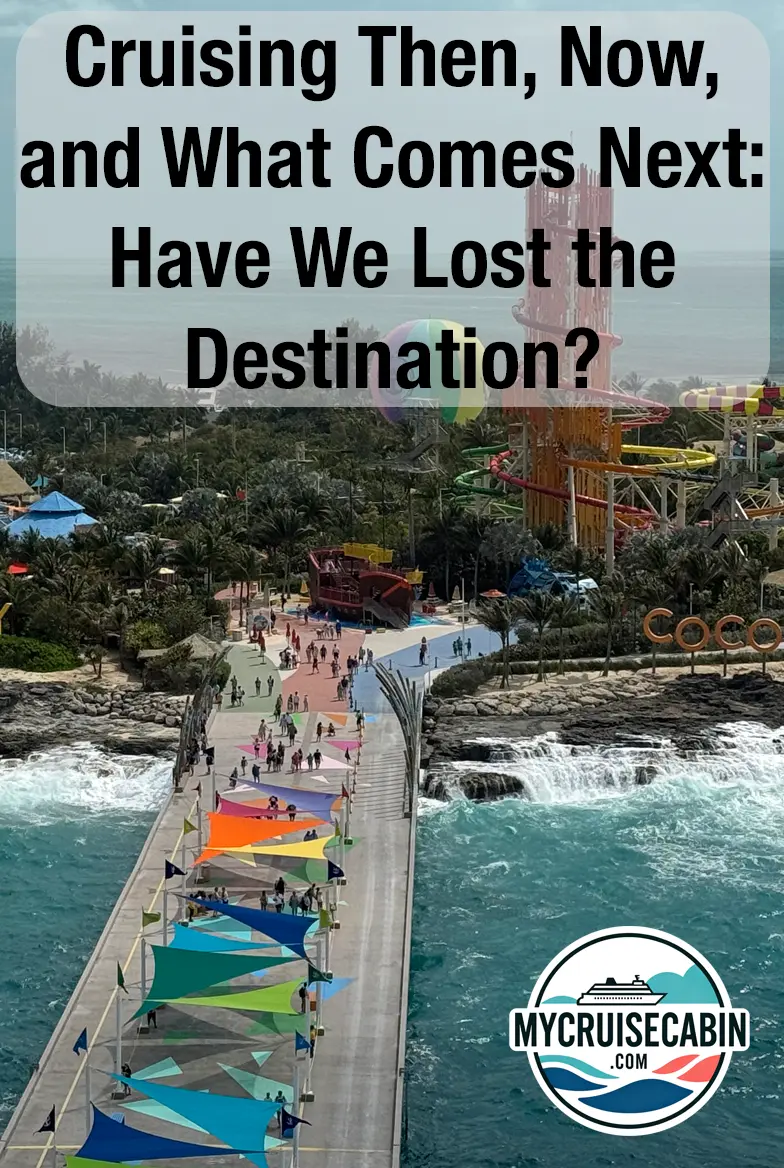
This took things to another level. Water park, helium balloon ride, swim-up bars, cabanas, and party areas. It’s not pretending to be a destination — it’s a full-scale cruise-branded theme park on land.
Passengers know these places are built by the cruise line and for the cruise line. And that’s fine — expectations are clear.
But private islands weren’t the end of it.
Secure Port Areas: When You Visit a Place Without Seeing It
The next evolution was the development of secure port zones — large, fenced-in areas controlled or heavily influenced by cruise lines.
These ports often include pools, swim-up bars, shopping villages, loungers, and entertainment — all within walking distance of the ship, and all inside security gates.
If you never leave, you never actually see the country you’re in.
Examples include:
Amber Cove, Dominican Republic
A beautifully designed port area with a massive pool, lazy river, bars, shopping, and views — all without ever stepping into the Dominican Republic beyond the gate.
Costa Maya, Mexico
A sprawling port complex with pools, bars, shops, and beach clubs. You can spend the entire day here and technically “visit” Mexico without interacting with local culture at all.
Icy Strait Point, Alaska
A bit different, but still controlled. It offers incredible access to nature and wildlife, but the experience is carefully curated and limited to specific areas.
There are many more like this — and more coming.
The Cruise Line Bubble
This is where things get interesting.
Between private islands and secure ports, it’s now possible to complete an entire cruise without ever leaving your cruise line’s ecosystem.
You step off the ship, but everything you see, eat, drink, buy, and experience is still owned, operated, or controlled by the cruise line.
Every cocktail.
Every souvenir.
Every photo.
It all flows back to the same place.
From a business standpoint, it’s brilliant.
From a travel standpoint… it’s complicated.
The Future: More Control, Not Less
Looking ahead, the trend is clear.
Disney now has two private islands.
Royal Caribbean is building Perfect Day Mexico at the Costa Maya port.
They’re also developing a beach club on Paradise Island in Nassau, Bahamas.
The model works. Passengers like it. Cruise lines love it.
Future itineraries may include more “destinations” that are effectively extensions of the ship itself.
You’ll technically visit multiple countries — but you may never really experience them.
So What Happened to Seeing the World?
This is the big question.
Did cruising lose its soul?
Or did travelers simply change?
Some people don’t want culture shock. They don’t want language barriers, unfamiliar food, or navigating cities. They want beautiful scenery, comfort, and predictability.
In that sense, cruising hasn’t failed — it has adapted.
At the same time, immersive, culture-focused travel hasn’t disappeared. It’s just shifted elsewhere. Smaller ships. Expedition cruising. River cruises. Backpacking. Independent travel.
Cruising, for many people, has become something else entirely.
Is Cruising Becoming a Theme Park Vacation?
In many ways, yes — and that’s not necessarily a criticism.
Modern cruising often feels like a floating theme park with themed lands on shore. Everything is designed to be easy, safe, and enjoyable with minimal effort.
For some travelers, that’s perfect. For others, something feels missing.
The good news is this: cruising is no longer one thing.
You can choose the bubble — or you can break out of it. You can stay inside the port gates, or you can walk into town. You can book the curated excursion, or hire a local guide.
The destination still matters — but only if you decide it does.
The Bottom Line
Cruising has evolved from a way to see the world into a way to experience the world comfortably. That tradeoff has brought incredible convenience, but it’s also changed the meaning of the destinations themselves.
The ship is no longer just the journey.
For many travelers, it’s the destination.
And whether that’s a loss or a win depends entirely on what kind of traveler you are — and what you hope to get out of your time at sea.
How do you feel about the loss of the authentic destination in exchange for the cruise line bubble? Drop a comment below!
Comments
Loading comments...
You May Also Like
Share Your Cruise Photos
Been on a cruise recently? Your cabin photos can help thousands of travelers make better booking decisions. Upload your photos and become part of our growing community of cruise enthusiasts!