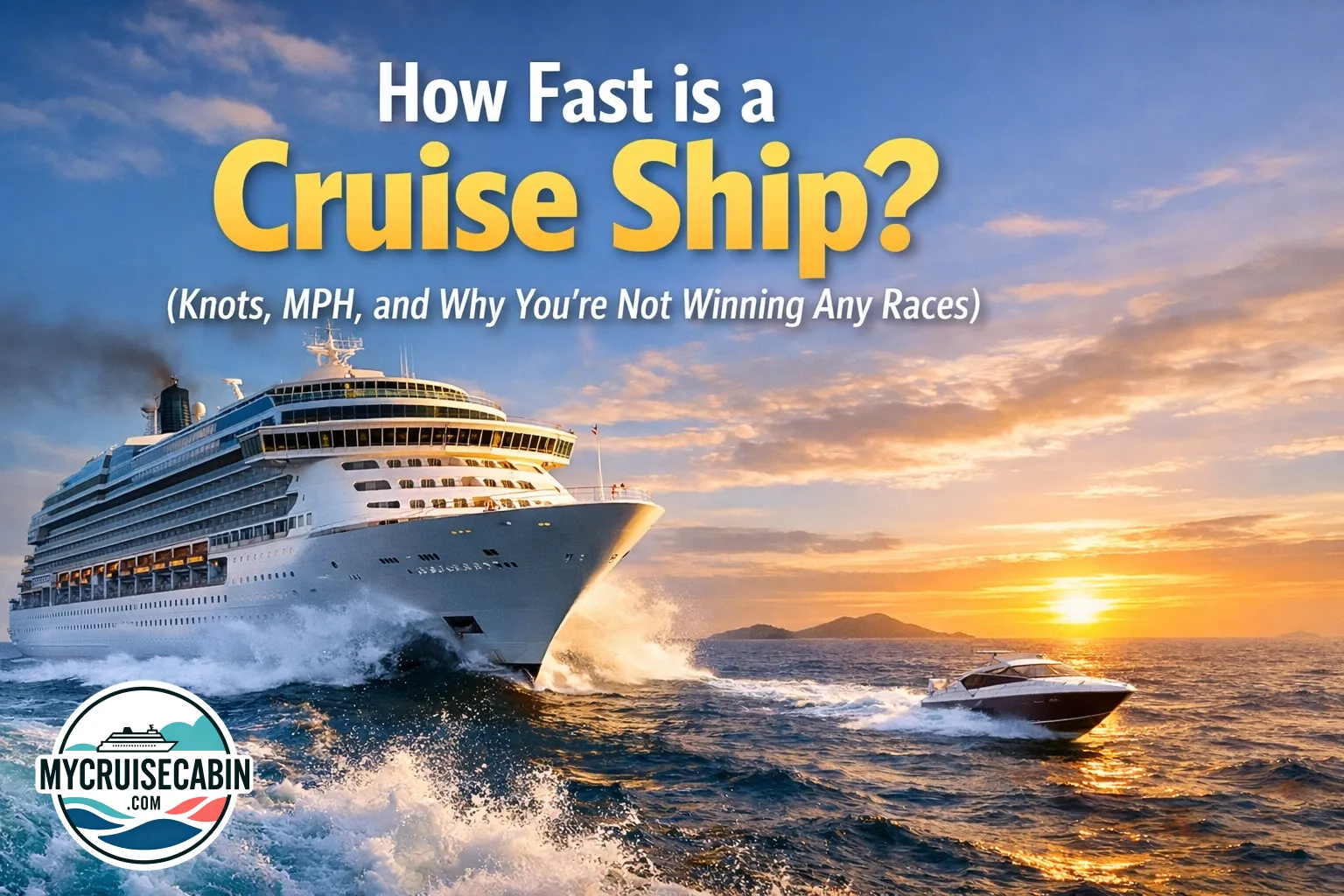
How Fast is a Cruise Ship? (Knots, MPH, and Why You’re Not Winning Any Races)
Have you ever stood on your balcony, looked down at the churning white water below, and wondered, "Are we actually getting anywhere?"
When you’re on a vessel that’s essentially a 20-story floating resort with three waterslides, a steakhouse, and a thousand crew members, it’s hard to gauge exactly how fast you’re moving. You aren't exactly feeling the G-force of a takeoff or the vibration of a highway. In fact, most of the time, you could probably keep pace with the ship if you were a particularly motivated cyclist on the shore.
If you’ve ever looked at the TV in your cabin showing the "Bridge Cam" and saw a number like "18 kts" and thought, "Is that fast?", this post is for you. We’re diving into the world of nautical speed, converting those confusing knots into real-world miles per hour, and explaining why your captain isn't trying to win any drag races across the Atlantic.
What on Earth is a "Knot"?
Before we talk about how fast a ship goes, we have to talk about how we measure it. In the world of maritime travel, we don't use miles per hour (mph) or kilometers per hour (kph). We use knots.
A "knot" represents one nautical mile per hour. Now, don't let the word "mile" fool you, a nautical mile is actually longer than a standard "statute" mile you’d drive on land. While a land mile is 5,280 feet, a nautical mile is approximately 6,076 feet. It’s based on the earth’s circumference and represents one minute of latitude.
If your brain is already starting to hurt from the math, here is the cheat sheet for conversions:
1 Knot ≈ 1.15 mph
1 Knot ≈ 1.85 kph
So, when the captain announces you are cruising at 20 knots, you are actually doing about 23 mph. For our friends using the metric system, that’s roughly 37 kph.
Historically, sailors actually used a rope with knots tied at specific intervals and a piece of wood to measure speed. They’d throw the wood overboard and count how many knots slipped through their fingers in a set amount of time. Luckily, today’s ships use high-tech GPS and pitometer logs, so no one has to lose a finger counting rope.
How Fast Do They Actually Go?
Most modern cruise ships have a typical cruise ship speed of about 20 to 25 knots.
Even the biggest behemoths at sea, like the ones you’ll see if you browse the Carnival Cruise Line fleet, generally stay in this sweet spot. While some ships can push it to 30 knots in an emergency (like outrunning a storm or making up time for a medical diversion), they rarely do.
To put this into perspective, let’s look at some comparisons that might surprise you.
The Cruise Ship Speed Comparison (The Slow and the Curious)
If you were to line up a cruise ship against other common modes of transport, the results would be pretty hilarious.
1. The Golf Cart (Approx. 12–15 mph)
A standard golf cart is actually slower than a cruise ship. If you were racing a cruise ship on a very long, very wet golf course, the ship would eventually pull ahead. However, in a tight port area, that golf cart feels like it's flying compared to the slow, methodical docking process of a 100,000-ton vessel.
2. A Bicycle (Approx. 15–20 mph for a decent rider)
This is the closest match. If you are a casual cyclist hitting a local trail, you are traveling at roughly the same speed as a massive cruise ship crossing the Caribbean. Think about that next time you’re at the buffet, you’re basically "biking" to Cozumel, just with a lot more shrimp cocktail and significantly less spandex.
3. A Speedboat (Approx. 40–60+ mph)
There is absolutely no contest here. A typical speedboat or those "yellow boat" tours you see at various ports will leave a cruise ship in the dust (or the spray). A speedboat is built for agility and velocity; a cruise ship is built to be a stable, floating city.
4. A Commercial Jet (Approx. 500–600 mph)
Don't even try it. While the ship is taking seven days to do a loop of the Western Caribbean, a plane has already gone around the world and back. But hey, does the plane have a "Hairy Chest Contest" or a 24-hour pizza station? We didn't think so.
Why Don’t They Go Faster?
You might be thinking, "We have the technology. Why can't we make a cruise ship go 60 mph and get to the private island in two hours?"
There are three major reasons why your captain keeps the pedal... well, not quite to the metal.
1. Fuel Efficiency (The Wallet Factor)
The amount of fuel required to move something as heavy as a cruise ship increases exponentially with speed. Pushing a ship from 20 knots to 30 knots doesn't just use 50% more fuel: it can use double or triple the amount. To keep cruise fares affordable, cruise lines find the "sweet spot" where they move efficiently without burning through the entire year's budget in one crossing.
2. Passenger Comfort (The "Sea Sick" Factor)
The faster a ship goes, the more it reacts to the waves. At 20 knots, a modern ship with advanced stabilizers feels like it's sitting on a slab of concrete. If the captain cranked it up to 40 knots, you’d be wearing your dinner rather than eating it. The goal is to make sure you can walk across the pool deck without losing your balance.
3. Itinerary Timing
Cruising isn't about the destination as much as it is about the journey. If the ship went top speed, you’d arrive at every port at 3:00 AM while everything is closed. The schedules are carefully calculated so the ship arrives just as the sun comes up, giving you maximum time to explore.
The Speed Demons of the Sea
While most ships linger in the low 20s, there are a few exceptions. The most famous is Cunard's Queen Mary 2.
Because she is an "ocean liner" designed for transatlantic crossings rather than just a "cruise ship," she was built for speed and stability in rougher northern waters. She can reach speeds of about 30 knots (34.5 mph). That might not sound like much compared to your car, but for a ship that size, it’s practically supersonic.
If you’re interested in seeing the engineering marvels of different ships, you can check out our Ships gallery to see the varying hull designs that make these speeds possible.
Does Speed Matter When Choosing a Cabin?
Believe it or not, how fast a ship travels can impact your experience in your room. If a ship is high-tailing it to make up for lost time, you might notice a bit more vibration if you’re staying in a cabin near the aft (back) where the engines and propellers are working overtime.
Before you book, it’s always a smart move to look at real cabin photos and read reviews from other cruisers. They’ll often mention if a specific room felt "rumbley" during those high-speed stretches between ports.
If you want the smoothest ride at any speed: Aim for a mid-ship oceanview or suite on a lower deck.
If you love the sound of the wake: Go for the aft, but be prepared for a little extra "hum" when the captain decides to open it up.
Slow Down, You’re on Vacation!
Ultimately, the answer to "How fast is a cruise ship?" is usually "Just fast enough."
The magic of cruising is that you don't have to worry about the traffic, the directions, or how many "knots to mph" you’re currently doing. Your only job is to decide whether you want the chocolate melting cake or the cheesecake (pro tip: get both).
Discovering the right ship for your preferred pace is easy when you have the right tools. Whether you’re looking for a fast-paced mega-ship with non-stop action or a smaller vessel that takes the scenic route, we’ve got the data and the photos to help you decide.
Explore our Travel Agent Directory if you want a professional to help you find the perfect itinerary, or jump into our forums to ask veteran cruisers about their smoothest (and fastest!) sailings.
Snap a photo of the bridge display on your next trip and share it with us! We love seeing how different lines handle their transit times.
What’s the fastest you’ve ever seen your ship go on the navigation channel? Did you feel the difference in your cabin? Drop a comment below and let’s talk shop!
Comments
Loading comments...
You May Also Like
Share Your Cruise Photos
Been on a cruise recently? Your cabin photos can help thousands of travelers make better booking decisions. Upload your photos and become part of our growing community of cruise enthusiasts!