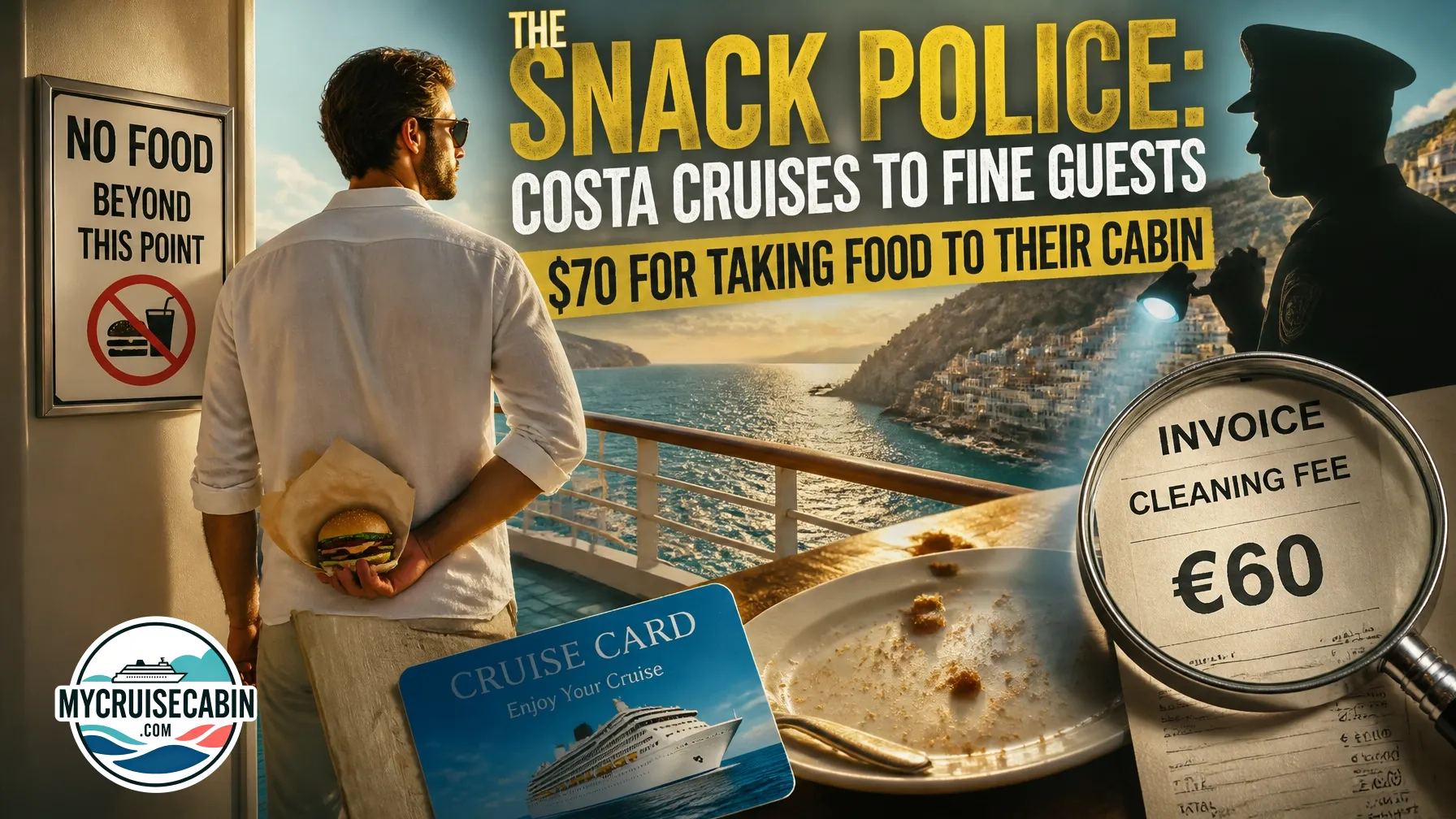
The Snack Police: Costa Cruises to Fine Guests $70 for Taking Food to Their Cabin
Picture this: You’re on a beautiful Mediterranean cruise, the sun is setting over the Amalfi Coast, and you’ve just grabbed a perfectly toasted panini from the buffet. You want nothing more than to take that sandwich back to your private balcony, kick up your feet, and enjoy the view with a quiet bite. But suddenly, you feel a presence. Is it the wind? No, it’s the "Snack Police."
In a move that has sent shockwaves through the cruising community, Costa Cruises has begun actively enforcing a policy that could cost you a staggering €60 (roughly $70 USD) if you’re caught taking food out of designated dining areas. Whether it’s a plate of pasta from the Main Dining Room or a simple cookie from the buffet, if it leaves the room, your onboard account might just take a hit.
The €60 Surcharge: How It Works
Snap! That’s the sound of the cruise line’s patience breaking. For years, cruise passengers have treated the entire ship like one giant dining room. We’ve all seen the half-eaten pizza slices left in elevator lobbies or the stacks of dirty buffet plates piled up outside cabin doors. Costa Cruises has decided they’ve had enough of the "free-for-all" dining culture.
The new rule is straightforward: All food must be consumed exclusively in designated dining areas. This includes the buffet, the Main Dining Room (MDR), and the poolside grills. If you are spotted walking out with a plate, or if your cabin steward finds "unauthorized" food remains in your stateroom, Costa reserves the right to levy a €60 "cleaning charge" directly to your bill.
This isn't just a suggestion tucked away in the fine print of the cruise contract anymore. Reports from recent sailings indicate that the cruise line is using signage and staff reminders to make sure everyone knows that the buffet is not a takeaway joint.
Why the Sudden Crackdown?
You might be wondering why a cruise line would risk the wrath of its passengers over a stray slice of cake. Costa Cruises claims the move is centered on two major pillars: hygiene and safety.
First, let's talk about the guests we don't want on board: pests. When food is carried throughout the ship and left in cabins or public lounges, it attracts unwanted visitors. Insects and rodents don't need a cruise ticket to enjoy a buffet, and keeping food confined to specific, high-turnover cleaning areas makes it much easier for the crew to manage pest control.
Second, and perhaps more importantly in 2026, is the issue of contamination and gastrointestinal outbreaks. We’ve seen a spike in Norovirus cases across the industry lately, and uncontrolled food transport is a nightmare for sanitization. When people handle food in the buffet, carry it through high-traffic hallways, touch elevator buttons, and then eat that food in a confined cabin, the risk of spreading germs skyrockets. By keeping the food in the dining rooms: where staff are constantly wiping down surfaces and monitoring hygiene: the cruise line can significantly lower the risk of a "Code Red" situation.
The Enforcement Dilemma: Who Are the Snack Police?
Discover! The real question on everyone’s mind is: how exactly do they plan to catch you? Are there undercover security guards hiding behind the soft-serve machine?
While we haven't seen "food marshals" patrolling the decks just yet, the enforcement likely falls on the shoulders of the hardest-working people on the ship: the cabin stewards and buffet attendants. Your cabin steward knows exactly what goes on in your room. If they walk in for the morning turnover and find a stack of dirty plates from the midnight buffet, they are now empowered (and perhaps required) to report it.
Enforcement at the buffet itself is a bit more awkward. Imagine a crew member having to stop a guest and ask them to return their plate to a table. It’s a recipe for "Karens at Sea" viral videos, but it shows just how serious Costa is about changing the onboard culture.
Nickel-and-Diming or Necessary Evil?
The reaction from the cruising community has been, predictably, spicy. Many long-time cruisers see this as another step in the "nickel-and-diming" of the passenger experience. We’ve seen the rise of "room service fees" and "automatic gratuities," and now a "fine" for eating your own food where you want feels like a bridge too far for some.
However, there is a flip side. If you’ve ever walked down a narrow cabin hallway and had to dodge a tray of rotting room service leftovers that’s been sitting there for 12 hours, you might actually be cheering this move. There is a certain level of "main character syndrome" that happens on cruise ships, and if a $70 fine is what it takes to keep the hallways clean and the Norovirus away, some passengers are all for it.
The Room Service Loophole
Before you start smuggling granola bars in your luggage, there is one major exception to the rule: Room Service.
If you order food through the official room service channel, you are perfectly fine to eat it in your cabin. Why? Because room service is a controlled delivery. The crew knows exactly which cabin has the food, they know when it was delivered, and they have a system for picking up the trays and sanitizing the area afterward. It’s the "uncontrolled" movement of food from the buffet that Costa is targeting.
How to Survive the Snack Ban
If you’re planning a trip on a Costa ship soon, you’ll need to adjust your habits. No more "grabbing a burger to eat while watching trivia" and no more "saving a dessert for later."
To keep your drinks cold and your cabin organized while you navigate these new rules, you might want to bring a few essentials. Since you can't bring the buffet to your room, you'll want to make sure your cabin is a comfortable sanctuary for the food you can have (like pre-packaged snacks you brought from home).
Amazon link to insulated water bottles
As an Amazon Associate, MyCruiseCabin.com earns from qualifying purchases.
Amazon link to magnetic hooks
As an Amazon Associate, MyCruiseCabin.com earns from qualifying purchases.
Insulated water bottles are a lifesaver for keeping your water or juice cold in the cabin without having to run back and forth to the beverage station. And magnetic hooks? They are the "secret weapon" of experienced cruisers for keeping your cabin tidy and keeping those "no-food" signs clearly visible on your door!
Looking at the Bigger Picture
Is this the future of cruising? While Royal Caribbean and Carnival Cruise Line haven't followed suit yet, they are undoubtedly watching Costa's experiment closely. If Costa sees a significant drop in cleaning costs and a decrease in health incidents, you can bet other lines will consider similar "cleaning fees."
Before you book your next trip, it’s always a good idea to check out the ships gallery and browse through real cabin photos to see exactly what kind of space you'll be working with. Sometimes, knowing the layout of the ship and where the dining areas are located can help you plan your meals better so you aren't tempted to break the rules.
The "Official Olympics" of Rule-Breaking
Cruisers are a resourceful bunch. We’ve already seen talk on the cruise line discussion forums about how to bypass the "Snack Police." From oversized pockets to hiding cookies in Tupperware, the "unofficial Olympics" of snack smuggling has already begun.
But honestly? Is a $70 fine worth a $0.50 croissant? Probably not. The best advice is to embrace the Mediterranean pace of life: sit down, enjoy your meal in the restaurant, people-watch, and leave the crumbs where they belong.
Share! What do you think about Costa’s new policy? Is it a smart move for health and hygiene, or is it just another way to squeeze money out of passengers? Have you ever been "fined" on a cruise for something unexpected? We want to hear your stories!
Whether you’re exploring the ports of Europe or just trying to figure out which cruise line fits your style, staying informed is the best way to ensure your vacation remains stress-free and fine-free.
Leave a comment below and let us know: would a "snack fine" stop you from booking with Costa Cruises, or do you think more lines should adopt this policy to keep the ships cleaner?
Comments
Loading comments...
You May Also Like
Share Your Cruise Photos
Been on a cruise recently? Your cabin photos can help thousands of travelers make better booking decisions. Upload your photos and become part of our growing community of cruise enthusiasts!