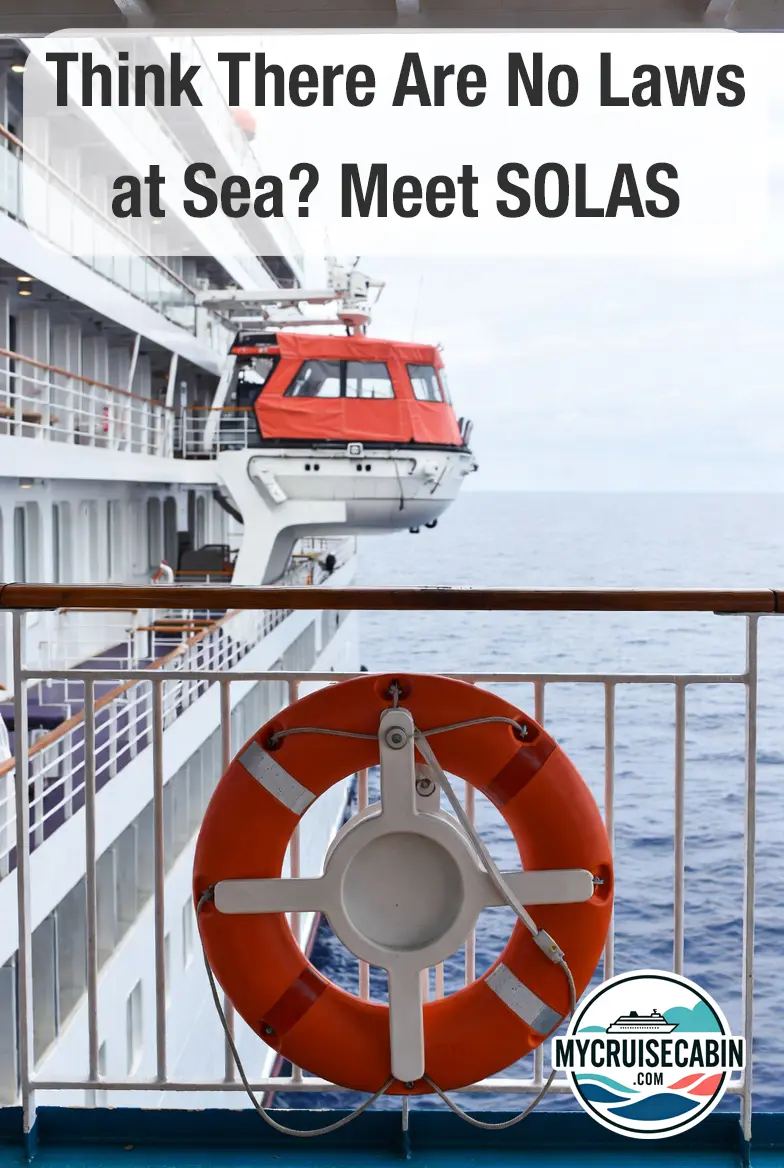
If you’ve ever heard someone say, “Once we’re in international waters, there are no laws,” here’s the truth: cruise ships don’t suddenly become floating outlaw towns. They operate under one of the most important maritime safety agreements in the world — SOLAS.
Understanding this clears up a lot of common questions:
Why do I have to do the muster drill?
Who’s actually in charge out at sea?
How do I know the ship has enough lifeboats?
Why does every ship follow the same procedures, no matter the itinerary?
Let’s break it down without the legal jargon.
SOLAS: The Global Rulebook for Keeping You Safe at Sea
SOLAS stands for Safety of Life at Sea.
It’s an international maritime treaty originally adopted in 1914 after the sinking of the Titanic. That disaster exposed how wildly inconsistent ship safety standards were from country to country — so nations agreed on a unified rulebook.
Today, SOLAS is maintained by the International Maritime Organization (IMO), a United Nations agency. Nearly every major seafaring country follows it.
What does SOLAS actually cover?
A lot, including:
How many lifeboats and life rafts a ship must carry
How lifeboats must be positioned and launched
Fire safety systems and prevention
Emergency power standards
Navigation systems
Training and emergency procedures for the crew
Yes — those muster drills you have to attend
SOLAS isn’t optional. If a cruise line wants to operate internationally, they must comply.
Who’s In Charge When You’re at Sea?
Even in “international waters,” laws absolutely exist.
Here’s how authority works:
1. The Flag State
The primary authority on a ship is the country whose flag the ship flies.
Example: If a ship is registered in the Bahamas, Bahamian maritime law applies.
This includes:
Safety oversight
Criminal jurisdiction (with limitations)
Compliance with SOLAS and other treaties
2. The Ship’s Master (Captain)
The captain has broad legal authority for the safety of the ship and everyone onboard.
Their decisions override everything else in an emergency — and SOLAS backs them up.
3. Port States
When the ship is in a country’s territorial waters (within 12 nautical miles), the laws of that country also apply.
4. International Maritime Regulations
Regardless of location, ships must follow global safety treaties like SOLAS, MARPOL (environmental), STCW (crew training), etc.
So no — it’s not lawless out there.
Why Do I Have to Do the Muster Drill Every Time?
Because SOLAS requires a muster drill within 24 hours of embarkation for every passenger, every cruise, every location.
You may think you “already know it,” but regulators assume:
People forget
Procedures change between ships
Not every ship has the same layout
The drill ensures everyone knows exactly:
Where their assembly station is
How to put on a life jacket (for lines that still require it)
What emergency signals sound like
Which stairwells lead where
It’s the one rule that has saved countless lives on ships that experienced real emergencies.
Does the Ship Have Enough Lifeboats?
Short answer: Yes — and then some.
SOLAS requires:
Enough lifeboat capacity for every single person onboard
Lifeboats split between both sides of the ship
Additional life rafts for redundancy
Modern ships are designed with lifeboat capacity far exceeding the minimum. Cruise ships can’t legally sail without meeting these requirements.
Who Enforces SOLAS?
SOLAS is enforced through multiple layers:
1. The Flag State
They inspect and certify vessels. No certificate = no sailing.
2. Classification Societies
Independent organizations (e.g., Lloyd’s Register, DNV) inspect ships on behalf of flag states. These are the engineers who get deep into the technical stuff.
3. Port State Control
Countries where cruise ships visit can inspect vessels at any time.
If something is unsafe, they can detain the ship on the spot.
4. Insurance + Cruise Lines
Insurance companies won’t insure a non-compliant ship.
Cruise lines can’t operate one.
Passengers wouldn’t sail on one.
It’s a tight system, and for good reason.
Bottom Line
International waters aren’t lawless — not even close. SOLAS is the backbone of modern cruise safety, and it’s why cruising is one of the safest forms of travel on earth.
So next time someone jokes about “no rules beyond the 12-mile line,” you can let them know that every muster drill, every lifeboat, every safety briefing, and every regulation is part of a global system designed to keep everyone safe — no matter where the ship sails.
Had you ever heard of SOLAS before? Did you realize that SOLAS is the reason for the muster drill and not the cruise line? Drop a comment below!
Comments
Loading comments...
You May Also Like
Share Your Cruise Photos
Been on a cruise recently? Your cabin photos can help thousands of travelers make better booking decisions. Upload your photos and become part of our growing community of cruise enthusiasts!