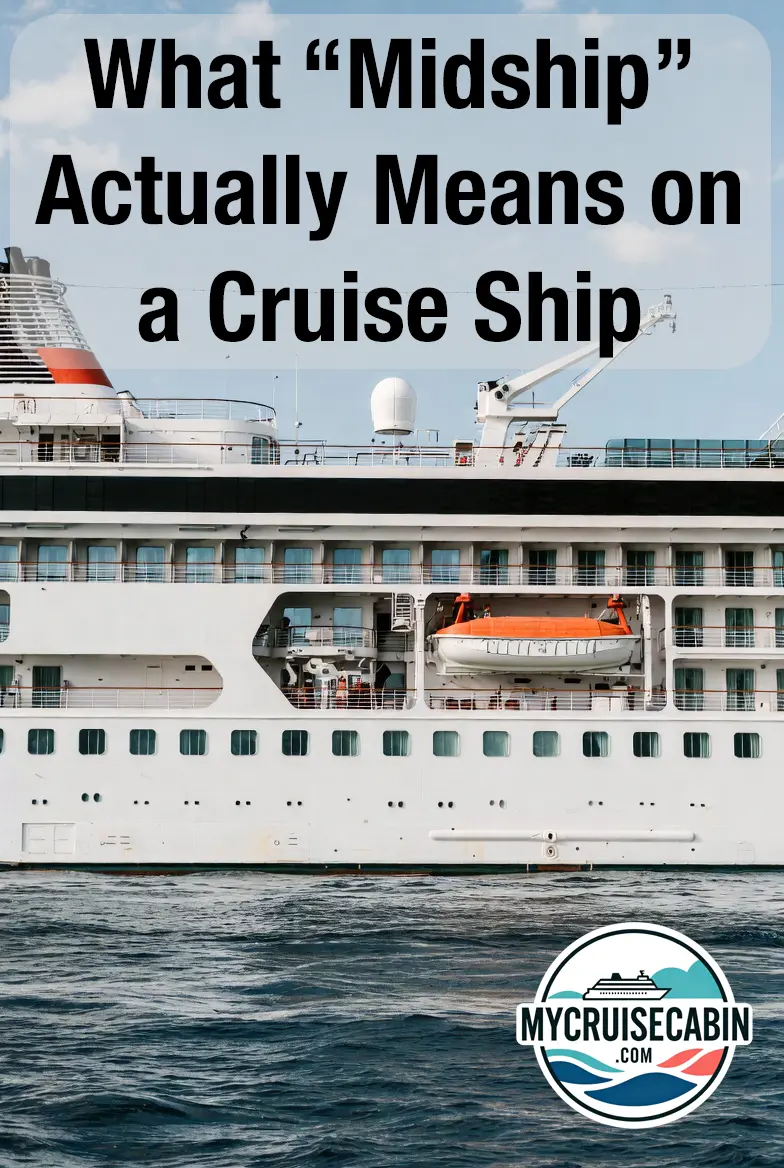
If you are shopping for a cruise cabin, “midship” sounds reassuring. It is often described as the best location on the ship—stable, convenient, and comfortable. That description is incomplete. Midship is not a magic zone, and misunderstanding it leads to bad cabin choices.
Here is what midship actually means, what it does not mean, and when it genuinely matters.
What “midship” means in real terms
Midship refers to the middle section of the ship from bow to stern. It has nothing to do with deck height and nothing to do with which side of the ship you are on. Think of the ship as a long rectangle split into thirds: forward, midship, and aft. That is it.
Cruise lines do not all define this section the same way. One line’s “midship” may be 30% of the ship; another’s may be closer to 20%. There is no industry standard.
Why midship is associated with less motion
The physics are simple. Ships pivot around their center. The farther you are from that center, the more motion you feel. Forward cabins experience more vertical movement. Aft cabins feel more vibration and propeller-related motion.
Midship cabins sit closest to the ship’s balance point. In rough seas, they usually experience less pitch and roll. This matters most if:
You are prone to motion sickness
You are cruising during rougher seasons
You are on a smaller ship
On large modern ships in calm seas, the difference is often minor.
The common misconception: midship = quiet
This is where people get burned.
Midship is frequently where:
Elevators are grouped
Stairwells are concentrated
High-traffic venues are stacked vertically
A midship cabin directly under a pool deck, buffet, casino, or theater can be louder than a forward or aft cabin on a quiet deck. Location above and below your cabin matters as much as fore/aft position.
Midship does not mean quiet. Deck placement determines noise far more than horizontal location.
Midship and walking distance
Midship cabins are often marketed as “convenient.” This is sometimes true and sometimes irrelevant.
If your ship’s main dining room is aft and the theater is forward, midship reduces average walking distance. If most venues you care about are clustered elsewhere, it does not.
For guests with mobility concerns, midship near elevators is helpful. For light sleepers, being too close to elevators can be a mistake.
Midship does not mean better views
View quality has nothing to do with midship. Obstructed views, lifeboats, overhangs, and hull curvature are deck- and ship-specific issues. You can have a perfect midship balcony with a terrible view or a forward cabin with an unobstructed panorama.
Never assume view quality based on “midship” alone.
When midship actually matters
Midship is worth prioritizing if:
You are sensitive to motion
You are booking during rougher weather
You are cruising on a smaller ship
You want balanced walking distances
Midship is not critical if:
You cruise calm itineraries
You sleep heavily
You care more about deck noise than motion
You found a quieter cabin elsewhere
The real takeaway
“Midship” is a partial data point, not a decision. Cabin quality is determined by a combination of:
Fore/aft position
Deck height
What is above and below
Exact cabin placement
Two midship cabins on the same ship can have completely different experiences.
That is why generic deck plans and marketing descriptions fall short—and why real cabin photos and real passenger feedback matter.
If you have stayed in a midship cabin—good or bad—post a comment below and share what you experienced. Real-world input helps other cruisers make better decisions.
Comments
Loading comments...
You May Also Like
Share Your Cruise Photos
Been on a cruise recently? Your cabin photos can help thousands of travelers make better booking decisions. Upload your photos and become part of our growing community of cruise enthusiasts!